
You Can’t Buy Your Way to Extreme Collaboration. You Have to Build It.
Technology can be copied; collaboration capacity must be built, this final article shows how to see and reduce Collaboration Debt.
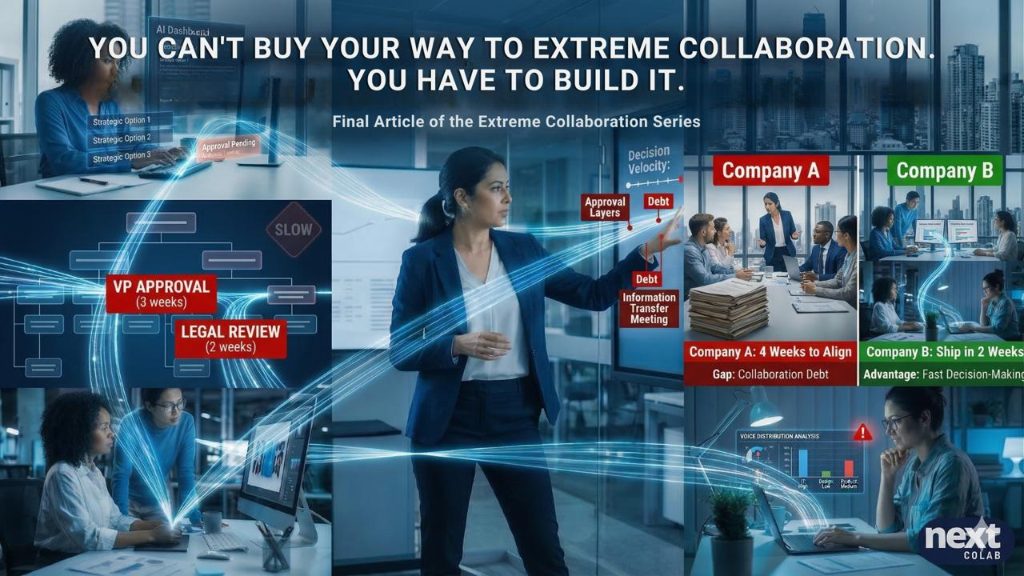
Extreme Collaboration Series — Article 5 (Final)
Every shift in how work gets done creates winners and losers. The printing press. The assembly line. The internet. Each one separated organizations that adapted their structures from those that simply adopted the technology. AI is no different — except the separation is happening faster.
This series started with a paradox: AI was supposed to give us back our time, and instead, it filled that time with more coordination, more decisions, more alignment requirements than any of us were prepared for. It elevated everyone's work to the executive level without the authority or structures to match. It dissolved the walls between departments while leaving power hierarchies intact. And it exposed how many of our meeting formats were solving problems we no longer have.
These aren't separate problems. They're symptoms of the same condition: Collaboration Debt — the accumulated cost of structures built for a slower era, compounding silently. And it shows up most clearly, most measurably, in your meetings.
Where Collaboration Debt Lives
Meetings are where collaboration debt becomes visible. Not in org charts or strategy decks — in the room where decisions either get made or don't. Where the same three voices shape every outcome, while others go unheard. Where thirty person-hours get spent presenting information that could have been a pre-read, leaving ten minutes for the judgment call that was the whole point.
McKinsey's 2025 research found that 70% of organizations report their biggest barrier to AI value isn't technical capability — it's organizational readiness. Decision-making speed. Cross-functional alignment. The willingness to change how work actually gets coordinated.
That coordination happens in meetings. Which means meetings are where the debt compounds — and where paying it down has to start.
What Your Meetings Are Actually Telling You
Most organizations have no real visibility into what their meetings accomplish. They know meetings are expensive. They suspect many are unnecessary. But they're operating on instinct rather than data.
Consider what's actually knowable. Whether your meetings produce decisions or just consume attention. Whether participation is genuinely distributed or whether the same voices dominate every session, regardless of who has the relevant expertise. Whether your cross-functional meetings are actually integrating perspectives or rubber-stamping conclusions that were reached before anyone walked in the room. Whether the meeting purpose — deciding, creating, coordinating, learning, building relationships — matches what the meeting actually does.
These patterns, tracked over time, tell you something precise about where your collaboration capacity is strong and where it's leaking. A team whose decision meetings consistently end without decisions has a problem that no AI tool will fix. A cross-functional group where the same discipline's framing wins every time isn't collaborating — it's performing collaboration while one perspective runs the table.
This is Collaboration Debt made visible. And visibility is where transformation starts.
The Moat Nobody Talks About
Technology can be purchased. AI tools can be replicated. A competitor can adopt your stack in a quarter.
What they cannot replicate quickly is collaboration capacity — the organizational muscle of deciding well under uncertainty, integrating diverse expertise without losing momentum, and building the trust that makes all of it sustainable. This takes time to build and is nearly impossible to fake. It shows up in whether your best people stay, in the quality of what gets shipped, in whether your organization moves at the speed your tools enable or the speed your structures permit.
The organizations that build it most durably are those that can collaborate across difference — across disciplines, hierarchies, backgrounds, and communication styles. Homogeneous collaboration is comfortable and fast in the short run but narrow. It misses the signal outside the dominant frame. Diverse teams have higher potential for breakthrough thinking, but only when there are explicit structures for integration (Edmondson, 2018). Inclusive collaboration isn't a values exercise. It's a performance strategy.
And it's not built in strategy sessions. It's built in the daily practice of how your meetings actually run.
What Separates Organizations That Get There
The barrier isn't awareness. Most leaders already know their coordination structures are outdated. The barrier is that Collaboration Debt is invisible until you measure it — and almost no one is measuring the right things.
- Not meeting attendance.
- Not whether the calendar is full.
- But whether meetings produce decisions.
- Whether participation is distributed in proportion to expertise.
- Whether the purpose of each meeting matches what actually happens in it.
- Whether patterns of voice and influence are shifting over time or calcifying.
When you can see those patterns, you can change them. You can redesign meeting structures that aren't working. You can develop individuals whose collaboration skills aren't keeping pace with their strategic responsibilities. You can make deliberate choices about whose expertise shapes outcomes rather than letting legacy dynamics run on autopilot.
The organizations building the Extreme Collaboration Advantage aren't just running better meetings. They're using what happens in meetings as a diagnostic — a continuous signal about where collaboration capacity is growing and where Collaboration Debt is still compounding.
The technology is ready. The advantage is available. The question is whether you can see clearly enough to build it.
This is the final article in the Extreme Collaboration Series. Next CoLab uses behavioral science and AI to measure what actually happens in your meetings — participation patterns, meeting effectiveness by purpose, and whether your collaboration is building capacity or burning it. Because you can't build what you can't see. Learn more at NextCoLab.com.
Sources Cited
- Aghina, W., De Smet, A., & Weerda, K. (2018). Agility: It rhymes with stability. McKinsey Quarterly.
- Edmondson, A. C. (2018). The Fearless Organization. John Wiley & Sons.
- McKinsey & Company. (2025). The state of AI in 2025.