
The Meeting Itself Is Obsolete: Old Rituals for a New Reality
Why recurring rituals built for a slower era must give way to pre-processed judgment sessions that spend the synchronous premium on human judgment.
Extreme Collaboration Series — Article 4
Your standing Monday meeting was designed in 1985 for information that moved slowly, decisions that moved more slowly, and people who couldn't just Slack each other. Why is it still on your calendar?
You're Paying a Premium You Can't Afford
Real-time human attention is the scarcest resource in organizations. Microsoft's 2025 Work Trend Index found that 80% of workers lack the time or energy to do their jobs and are interrupted 275 times per day. Time lost to unproductive meetings costs $399 billion annually (Rogelberg, 2019).
Call it Meeting Debt: the accumulated cost of collaboration structures designed for a different era, compounding every time you click “Accept” on a recurring invite.
When you call a meeting, you're spending the Synchronous Premium — finite, expensive, irreplaceable. The old calculus was: if we need to communicate, we should meet. The new calculus has to be harder: what requires synchronous human attention that we absolutely cannot accomplish any other way?
The answer is narrower than most calendars suggest.
Five Reasons to Actually Meet
When you look honestly at what meetings do, five legitimate purposes emerge. Some meetings decide — they close a question, make a commitment, choose a course of action. Others create and solve — working through a live production incident, a design challenge, or a problem that genuinely resists async treatment. A third category coordinates and executes: the standup, the project sync, the checkpoint that keeps distributed work from diverging — and yes, status updates live here too, though most of them belong in a dashboard, not a calendar invite. A fourth shares and builds knowledge — the all-hands, the briefing, the training. And a fifth builds relationships that make everything else possible: the 1:1 that's actually about trust, the retrospective where a team finally says the thing they've not been saying.
The problem isn't that these five purposes exist. It's that most meetings on most calendars don't honestly belong to any of them.
What You're Actually Scheduling
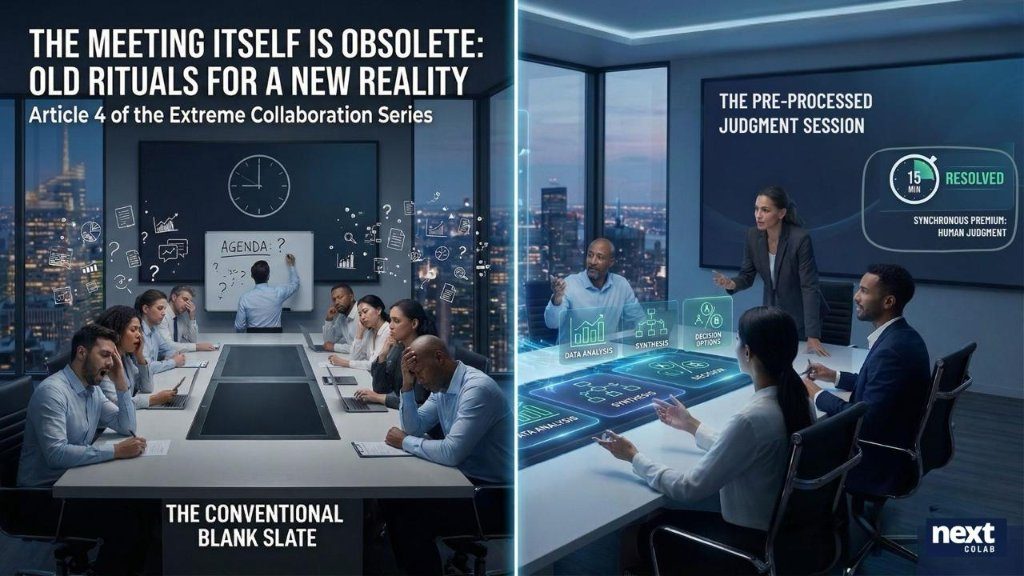
The information-sharing meeting is a document waiting to be written. The brainstorm that needs pre-processed AI ideation gets scheduled as a blank-slate sync instead — forty minutes generating options, ten minutes on the judgment call that was the whole point. And then there's the meeting that exists because it has always existed: the Monday standup nobody can justify, the weekly all-hands that stopped being necessary two reorgs ago.
That last category is pure Meeting Debt. You're paying interest on a 2018 decision.
The distinction that matters isn't between good and bad meetings. It's between meetings where synchronous human attention is genuinely irreplaceable and meetings where it isn't. Working through a live incident as it unfolds requires it. Delivering a status update that hasn't changed since last week does not.
Pre-Processing Changes the Math
The conventional meeting gathers thirty people for an hour — thirty person-hours — presents information for forty-five minutes, discusses for ten, and schedules a follow-up. The pre-processed version works differently. AI synthesizes inputs into a brief that everyone reviews beforehand. The meeting runs for thirty minutes, starts with the decision or the problem, and ends with something resolved. You've saved more than twenty person-hours and eliminated the follow-up.
The Synchronous Premium is for human judgment, navigating ambiguity, and building the relational trust that makes collaboration durable. Not information processing. Not status theatre.
This Is Also an Equity Question
Meeting culture is never neutral. The open brainstorm privileges extroverts. The leadership sync privileges whoever has the executive's attention. When AI accelerates everything, these patterns don't slow down — they compound.
Pre-processed meetings level the ground between fast processors and deep thinkers. Decision sessions with explicit frameworks for whose expertise carries weight make visible choices that used to be invisible. Research confirms it: structured meetings increase psychological safety and distribute participation more evenly (Edmondson, 2018).
Where to Start
Audit two weeks of your calendar. For every meeting, ask what it actually does. Which of the five purposes does it serve? Could it be async? If it must be synchronous, what's the irreducibly human work?
Kill what exists by inertia. Convert information sharing to pre-reads. Redesign what remains around a single named purpose, pre-processed, designed for the judgment only humans can make.
The formats are obsolete. The debt is optional.
The meeting itself is obsolete. Not human collaboration, judgment, and connection. Just the formats we inherited.
The question is whether you'll redesign them or keep paying Meeting Debt until your best people burn out from a calendar full of 1985.
This is Article 4 of the Extreme Collaboration series. Learn more at Next CoLab, where behavioral science, business science, and AI measure what meetings accomplish and redesign them for work that matters.
Sources Cited
- Edmondson, A. C. (2018). The Fearless Organization. John Wiley & Sons.
- Microsoft. (April 2025). 2025 Work Trend Index annual report: The year the frontier firm is born.
- Rogelberg, S. G. (2019). The Surprising Science of Meetings. Oxford University Press.