
The Collaboration Paradox: Is AI Creating More Meetings, Not Fewer?
AI is accelerating output, but shifting the bottleneck to alignment, judgment, and commitment, making collaboration the real work.
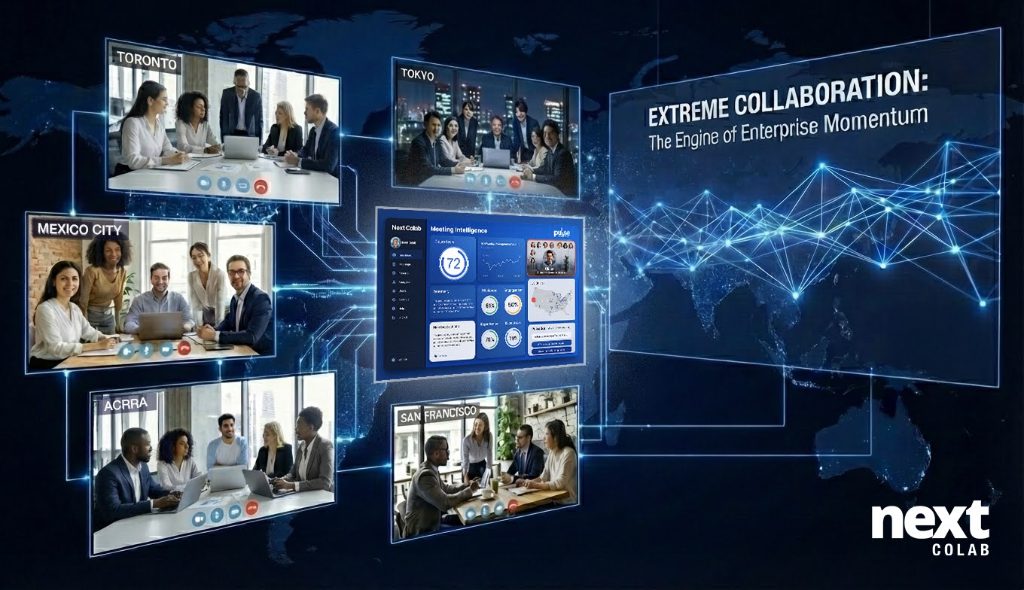
Extreme Collaboration Series — Article 1
"AI promised to give us back our time. Instead, it's giving us more of each other."
The Promise and the Reality
Every productivity tool promised to eliminate meetings. Email would replace them. Slack would replace them. AI would definitely replace them. And yet …
The number of meetings has tripled since 2020. Seventy-eight percent of employees say they attend so many meetings that it's hard to get their actual work done. Forty-five percent feel overwhelmed by meeting volume alone. Time wasted in unproductive meetings has doubled since 2019, now consuming five hours per week. The cost? An estimated $399 billion is lost annually to meetings that accomplish nothing.
We've been solving the wrong problem.
The assumption was that technology would make meetings unnecessary by giving us better asynchronous alternatives. But that assumption missed something fundamental about how work is changing. AI doesn't reduce the need for human collaboration. It concentrates and intensifies it.
We are in an era of EXTREME COLLABORATION.
What Is Extreme Collaboration?
Extreme Collaboration can be defined as the emerging reality of work in the AI era; a world where human coordination becomes the primary mode of work itself, not a supplement to it.
Here's why this is happening: When AI can produce a month's worth of analysis in an afternoon—when consultants using AI complete tasks 25% faster and produce 40% higher quality results—the bottleneck shifts.
The constraint is no longer production capacity.
It's decision-making capacity.
It's alignment capacity.
It's the ability to integrate, synthesize, and commit.
In other words, what remains after AI handles the routine is the irreducibly human work. Deciding what matters. Aligning on direction and objectives. Building commitment across stakeholders. Navigating disagreement. Making judgment calls with incomplete information.
This is not collaboration as we've known it—the periodic check-in, the status update, the information-sharing meeting. This is collaboration as the work itself, what we call "Extreme Collaboration."
"Collaboration isn't the overhead anymore. Collaboration is the work."
The Collaboration Paradox Explained
The Collaboration Paradox is simple to state: More AI productivity creates more human cooperation requirements, not fewer.
Consider what happens when AI accelerates output. Your team can now generate five strategic options, where before you could only develop two. Your analysis is deeper, your scenarios more comprehensive, your materials more polished. This is genuine progress.
But someone still has to choose between those options. Someone has to get stakeholders aligned on the direction. Someone has to integrate the AI-generated analysis with organizational context, political realities, and human judgment that no algorithm possesses.
That "someone" is usually a group. And that group needs to meet.
Research from the St. Louis Federal Reserve shows that workers using generative AI save an average of 5.4% of their work hours, which translates to 2.2 hours per week for someone working a standard 40-hour week. Daily users saved significantly more: 33.5% of daily users saved ≥4 hours per week, versus only 11.5% of those who used AI just one day per week. But where does that time go? Not to the beach. It goes to the coordination required to do something with all that additional output—more review cycles, more alignment conversations, more integration across functions and perspectives.
Managers now spend an average of 13 hours per week in meetings—more than 20% of their workweek. For directors and above, 67% report working overtime specifically because of meeting overload. Eighty percent of workers say they'd be more productive with fewer meetings, yet meeting volume continues to climb.
The paradox isn't a failure of AI. It's a signal that we've entered a new phase of work itself.
The Shift from Doing to Deciding
Understanding the Collaboration Paradox requires recognizing a fundamental shift in what work means.
For most of industrial and knowledge-work history, individual contribution was the primary mode of work. You did your tasks. Occasionally, you coordinated with others to align inputs and outputs. Then you went back to doing.
AI inverts this ratio. Individual production shrinks; collective navigation expands. The ratio of "doing" to "deciding" tilts decisively toward deciding.
This isn't because AI makes decisions poorly—increasingly, it makes certain kinds of decisions quite well. It's because the kinds of decisions that matter most are the ones AI cannot make: decisions about values, priorities, tradeoffs, commitments, and relationships.
When AI can draft the strategy document, the human work becomes debating whether it's the right strategy. When AI can generate the budget scenarios, the human work becomes building commitment to one of them. When AI can produce the communication, the human work becomes ensuring it lands with the right stakeholders in the right way.
All of this requires collaboration. Not the old kind—information transfer that could indeed be replaced by an email. The new kind: collective sensemaking, judgment integration, and commitment building that only humans can do together.
The Meeting Question
If we're all communicating and collaborating all the time—via Slack, Teams, email, shared documents, async video—then what is the meeting actually doing? How is it adding value?
In the Extreme Collaboration era, this becomes a sharper question than ever. Synchronous human attention is now the scarcest resource. Seventy-six percent of workers feel drained on high-meeting days. Fifty-three percent report their workday is regularly interrupted by virtual meetings. Atlassian research shows that 55% of employees feel their input is undervalued in meetings.
The meeting, then, must justify itself differently. Not as a mechanism for information transfer—AI and async tools handle that better. But as the site where the irreducibly human work happens: where people come together to solve problems, align and make decisions at the same time that they have fun, feel they belong, and energize each other.
Meetings should be the engine of enterprise momentum—not a drain on time and talent. When they work, ideas become action and decisions become outcomes. When they don't, organizations lose not just time but the ability to move at the speed their AI tools enable.
What This Means for Leaders
Historically, in Western societies, "ideal" leaders are portrayed as heroic individuals making collaboration work invisible, undervalued, and largely unrewarded. Yet multiple decades of high-performance research in the social sciences show great teams consistently outperform brilliant individuals when it comes to solving complex problems and achieving breakthrough results.
If the Collaboration Paradox is real—and the data suggests it is—then leaders face a strategic choice. You can treat the surge in collaboration as overhead to be minimized or as the core competency to be developed.
The minimize-overhead approach leads to familiar tactics: cancel meetings, enforce meeting-free days, and create policies about meeting length. These can help at the margins. But they don't address the underlying reality that more AI capability creates more collaboration requirements.
The develop-the-competency approach leads somewhere different. It asks: If collaboration is now the work, how do we get genuinely better at it? How do we give meetings a memory and teams momentum? How do we fuse behavioral science and business science and AI to diagnose how teams work and where performance leaks—so progress becomes a habit, not an accident?
This approach recognizes that you can't optimize what you can't see. Most organizations have no idea how their collaboration is actually functioning. They have intuitions, frustrations, and a vague sense that things could be better. But they lack the data, the feedback loops, and the coaching infrastructure to make systematic improvement possible.
The Path Forward: From Paradox to Advantage
The Collaboration Paradox is not a problem to be solved once and forgotten. It's the new operating environment. AI will continue to advance. Output will continue to accelerate. And the human coordination requirements will continue to intensify.
Organizations that accept this reality—and invest in genuine collaboration capacity—will find themselves with a sustainable advantage. They'll move faster because their coordination is fluid. They'll decide better because their collective judgment is informed by diverse perspectives. They'll execute more reliably because their commitments are real, not performative.
Organizations that fight this reality—treating collaboration as the problem rather than the work—will find themselves perpetually overwhelmed. Their AI tools will generate options they can't evaluate, possibilities they can't align around, and outputs they can't integrate.
The future belongs to teams that don't just meet—they decide, act, and learn faster than the world changes.
Welcome to the era of Extreme Collaboration.
What's Next
This is Article 1 of the Extreme Collaboration series. Learn more about building extreme collaboration capacity at Next CoLab, where behavioral science, business science, and AI come together to transform how teams collaborate—so fewer, shorter, and more productive meetings become the norm, and progress becomes a habit, not an accident.
Sources Cited
- Archie App. (2025, October 28). "Work Meetings in Numbers: Latest Meeting Statistics [2025]." https://archieapp.co/blog/meeting-statistics/
- Asana. (2024). "2024 State of Work Innovation report findings on the hidden cost of unproductive meetings." https://asana.com/inside-asana/unproductive-meetings
- Atlassian. (2025, January 9). "Workplace Woes: Meetings." https://www.atlassian.com/blog/workplace-woes-meetings
- Bick, A., Blandin, A., & Deming, D. (2025). "The Impact of Generative AI on Work Productivity," Federal Reserve Bank of St. Louis Working Paper 2024-027C.
- Chanty. (2025, November 14). "Meetings Statistics: The Real Cost of Back-to-Back Calls." https://www.chanty.com/blog/meetings-statistics/
- Fellow. "Meetings Statistics: How Many Hours Do We Spend in Meetings?" https://fellow.ai/blog/meetings-statistics-how-many-hours-do-we-spend-in-meetings/
- Flowtrace. (2025, December 7). "100 Surprising Meeting Statistics for 2026." https://www.flowtrace.co/collaboration-blog/50-meeting-statistics
- School Management Plus. (2024, August 29). "Are your staff holding too many meetings?" https://www.schoolmanagementplus.com/heads-governors-school-leadership-governance/leadership-are-your-staff-holding-too-many-meetings/
- The Treetop. "Startling Time Wasted in Meetings Statistics." https://www.thetreetop.com/statistics/time-wasted-in-meetings-statistics
- Van Vlissingen and Co. (2025, September 22). "Bad Meetings Are More Expensive Than You Think." https://www.vvco.com/bad-meetings-are-more-expensive-than-you-think/
- Zippia. (2023, July 7). "28+ Incredible Meeting Statistics [2023]: Virtual, Zoom, In-Person Meetings And Productivity." https://www.zippia.com/advice/meeting-statistics/